
In our survey, we asked IT services firms whether they use generative AI tools such as OpenAI’s ChatGPT, Google Gemini, Microsoft Copilot, Perplexity AI, or others to conduct thought leadership research. To shed light on this, we asked them about their use of such AI in nine general steps in the research process – beginning with topic selection and ending with multimedia content creation.
In each of those research steps, at least 31% of the IT services firms are using generative AI. Said Jerome Buvat, Capgemini’s thought leadership research chief: “I believe AI can be tremendously helpful in every stage of our thought leadership research process – starting with scoping, what’s been written on a certain topic.”
(Our survey did not ask them about how they use generative AI in marketing their research. But we did have several discussions about that in our interviews with heads of thought leadership.)
We found nearly six in 10 of IT services firms use generative AI tools to write prose for the research they publish: reports, white papers, blog posts, and other content formats. That surprised us. We thought many more were using generative AI to decide on topics to research (using ChatGPT et al for “white space” analysis – seeing what others have written). But writing from whole cloth with generative AI – or using the technology to write prose from a human-written outline? We assumed more companies would think, “If it’s thought leadership, it needs to be our words – not AI’s words.” Apparently not.
Said one former senior executive at a midsized IT services firm: “I have been a proponent of doing CXO surveys” to develop thought leadership content. “I tried doing that at [his prior firm]. But even a $20,000-$30,000 budget to poll 500 executives globally was thought of as [extravagant]. They said, ‘Why do we need to spend that money? We can just ask ChatGPT to write something.’ The notion of making it fact-based, research-based is not very intuitive in the tech services world.”
We also surveyed executives in 11 industries, all of whom play key roles in deciding which IT services firms to hire. From their answers, we believe IT services firms must tread cautiously with generative AI in thought leadership. We asked these 200 executives how they view thought leadership content from IT services (or any other companies) that used generative AI to help create the content. Did they trust such content? We asked them to select one of these four answers:
- “I would not trust it.”
- “I would trust it because I realize it is useful in developing content. I just want to know where and how they use it.”
- “I trust the output of generative AI as much as I trust that of human beings.”
- “I have no opinion on this topic.”
Nearly three-quarters (72%) said they would trust the output. However, most of them (58%) want to know where and how generative AI was used in the content. More than a quarter (28%) said they would not trust content from IT services and other companies that used generative AI to produce it. That was twice the percentage of those who said they’d trust the output of generative AI as much as they’d trust the output of human beings. (See Exhibit 56.)
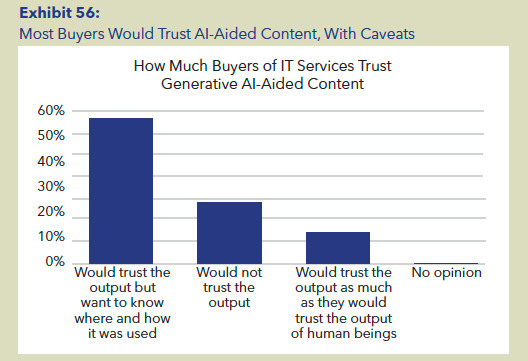
What this says to us: To try to convince the 28% of buyers of their services who don’t trust the output of generative AI, IT services firms must explain where and how they use the technology, and that they verified the output was accurate. It might also help to communicate why their IT services firm used generative AI – for example, to uncover hard-to-find previous research studies in the marketplace that had important data to share, to summarize long interview transcripts (and thus free researchers to conduct additional interviews), and so on.
How IT Services Firms are Using Generative AI in Thought Leadership
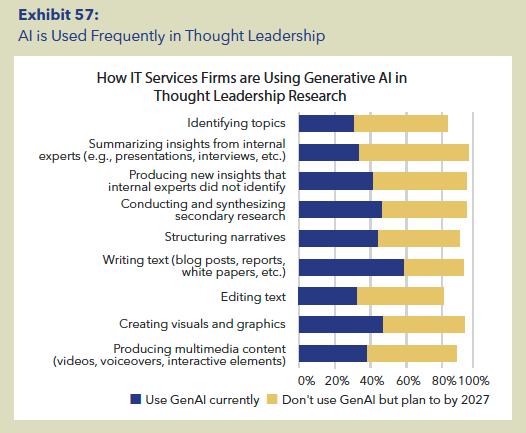
How exactly how are IT services firms using generative AI in their thought leadership research process? We asked about nine aspects of developing research-based content – whether they were using it today and, if not, whether they expect to use it by 2027.
By far, they are most frequently using it to write the prose for research output: research reports, white papers, blog posts, and so on. Some 59% do this today, and another 33% aren’t but plan to by 2027. (See Exhibit 57.) That was surprising: Almost twice as many IT services firms are using generative AI to write prose than to editprose (33%). In four other areas, at least 40% of IT services are using generative AI:
- Conducting and synthesizing secondary research (47%)
- Creating visuals and graphics (47%)
- Structure narratives/outline for articles, reports, etc. (45%)
- Creating new insights that internal experts did not identify (42%)
Less than 40% of IT services firms are using generative AI today in four other areas: producing multimedia content; summarizing insights of internal experts; editing text; and identifying topics to research.
By the way, these aren’t the only ways to use generative AI in thought leadership research. In our conversations with heads of thought leadership (conducted after we fielded our online survey), they told us about other inventive ways they’re the technology. For example, Capgemini’s Buvat said his firm uses an AI to assess the quality of its research on five criteria, on a zero to 20 scale. The tool then provides specific recommendations on how to improve it. “This is very helpful, and it saves us a lot of review time,” he said.
The Best IT Services Firms at Thought Leadership Use Generative AI Less Than Followers Use It
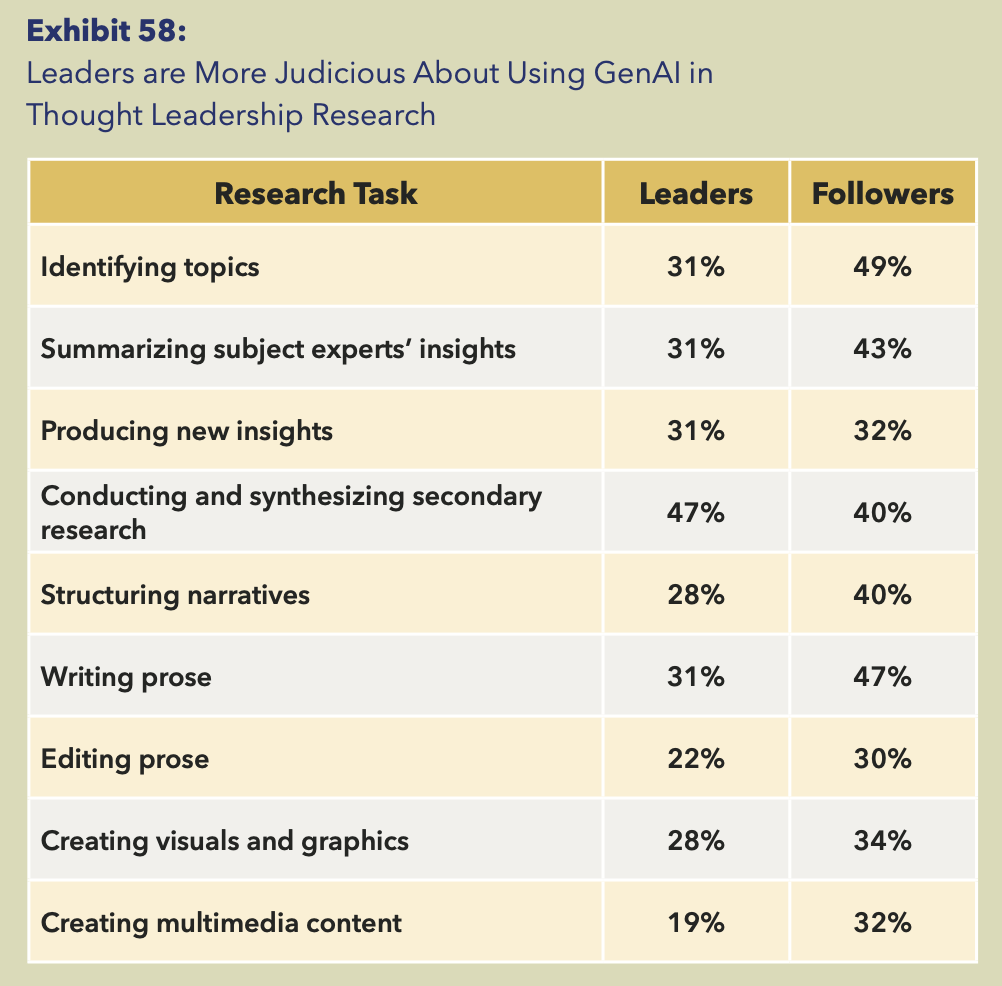
Are the best IT services firms at generating revenue from thought leadership (firms we designate as Leaders) using generative AI more aggressively than Followers? In most cases, it’s the opposite: Followers are more often using generative AI than are Leaders – in eight of the nine areas we asked them about. The only area in which Leaders are leading here is using generative AI to conduct secondary research and synthesize the findings.
The four biggest gaps between Leaders and Followers in using generative AI today are these (Exhibit 58):
- Identifying topics: 49% of Followers are using generative AI here vs. 31% of Leaders (an 18 percentage-point difference)
- Writing prose: 47% of Followers vs. only 31% of Leaders (16-point difference)
- Creating multimedia content: 32% of Followers vs. only 19% of Leaders (13-point difference)
- Structuring narratives: 40% of Followers vs. 28% of Leaders (12-point difference)
How can this be explained? First, the data shows that some Leaders are using generative AI today in creating thought leadership content. And by 2027, the majority said they would be using the technology here.
However, right now, Leaders are more cautious about where and how they use generative AI in thought leadership content development. Here’s our take on why:
- Nearly half (47%) of Leaders use it today to conduct secondary research and summarize the findings. All Leaders plan to do this in two years. Generative AI has proven to be an unprecedented tool in collecting data from the Web – studies, white papers, case examples and more (from the media, books, academic research data bases, and more). Leaders recognize generative AI’s value as a secondary research tool.
- Less than a third (31%) of Leaders use generative AI today to write prose, and 28% use it to write outlines. In contrast, nearly half (47%) the Followers use the technology to write prose, and 40% to write outlines. Leaders are less willing to outsource sense-making – coming up with insights, structuring an argument, and codifying it with text – than are Followers. Leaders want their thought leaders to do the firm’s thinking, not outsource it to an AI tool.
To be fair, only 32% of Followers use generative AI today to generate new insights from their thought leadership research – i.e., insights that their internal experts hadn’t uncovered. That’s about the same percentage as the Leaders (31%).
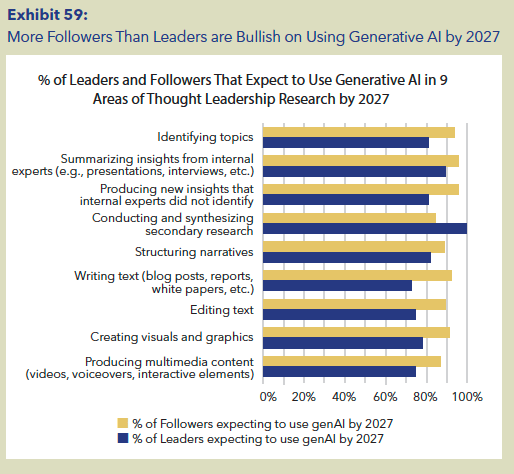
Yet by 2027, a higher percentage of Followers than Leaders expect to use generative AI in thought leadership in eight of nine areas. To be sure, Leaders are bullish on the technology, but not nearly as much as Followers – other than using it to conduct and synthesize secondary research. (See Exhibit 59.)
It’s clear to us that generative AI is here to stay in thought leadership research. It remains to be seen whether it will be a game-changer in helping IT services gather data on digital practices in the marketplace, determine what separates the best from the rest, and explain it compellingly.
Nonetheless, we believe IT services firms should be experimenting heavily with generative AI tools to automate key pieces of what for decades has been a tedious manual process.
 Outthinking the Competition